
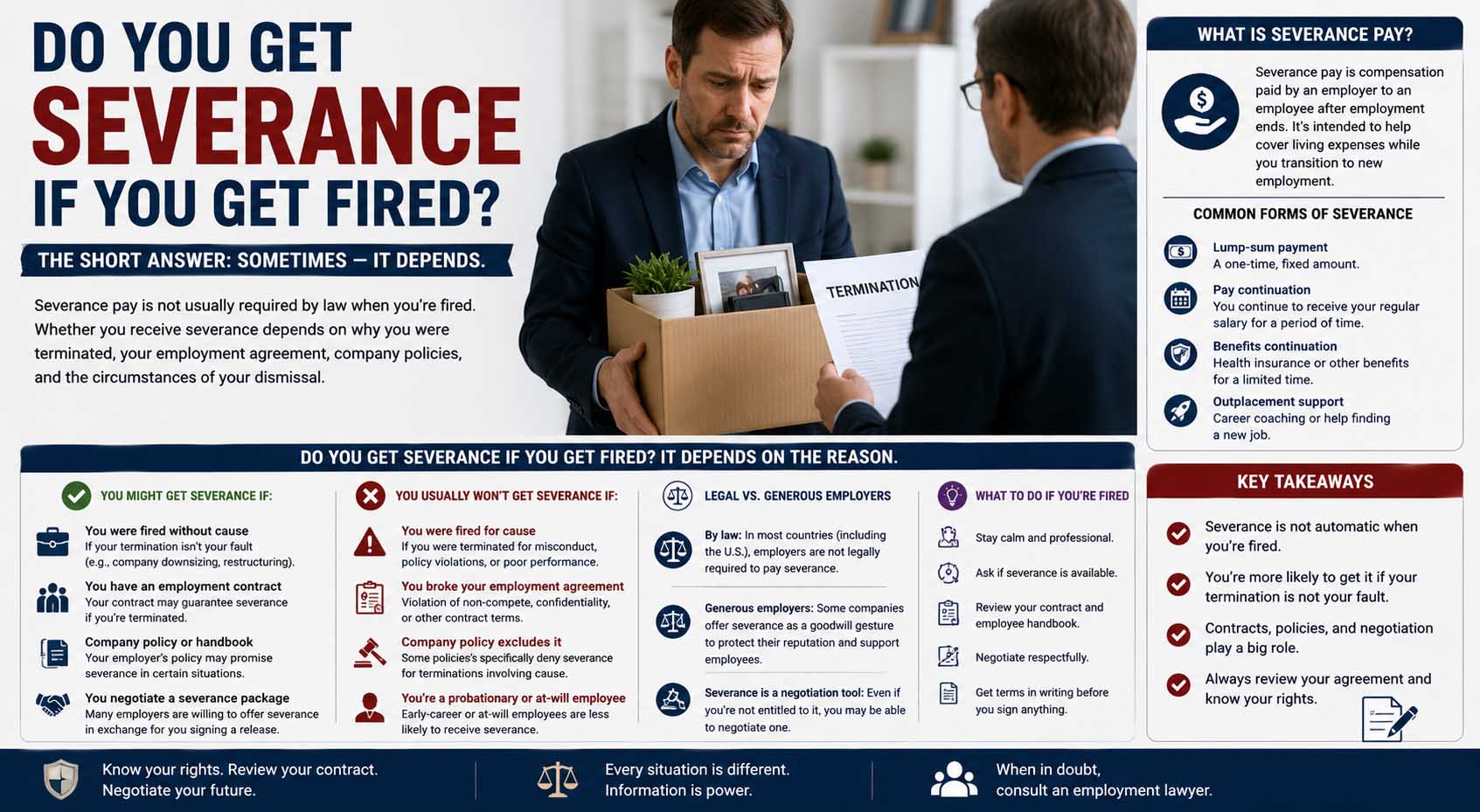
Do You Get Severance If You Get Fired? How Severance Packages Work
Losing a job can bring an immediate question about money: do you get severance if you get fired? The short answer is sometimes, but not automatically. In the United States, federal law generally does not require employers to provide severance pay simply because an employee is terminated. However, you may receive severance if your employment contract, collective bargaining agreement, company policy, established severance plan, or negotiated separation agreement provides it.
The reason for termination can also matter. An employer may offer severance after restructuring or a position elimination while providing nothing when an employee is terminated for serious misconduct. Since policies vary widely, the best place to start is your employment documents and the written terms the employer gives you when employment ends.
What Is Severance Pay?
Severance pay is compensation or benefits that an employer provides to an employee when the employment relationship ends.
A severance package can consist of a single lump-sum payment, continued salary for a set period, or another arrangement established by the employer.
Depending on the package, it may also address benefits, unused paid time off, bonuses, commissions, stock-related matters, references, confidentiality, and other separation terms.
However, severance isn’t the same as a final paycheck. Employees may already be legally entitled to earned wages, while severance is generally a separate benefit or contractual payment.
Therefore, read every part of the separation paperwork instead of assuming that all money offered after termination represents severance.
Do You Get Severance If You Get Fired or Only Laid Off?
Being “fired” and being “laid off” can describe very different employment situations.
A firing usually refers to an employer terminating a particular employee, potentially because of performance, conduct, attendance, policy violations, or another individual reason.
A layoff, by contrast, commonly results from a business decision such as restructuring, reduced demand, budget cuts, facility closure, or elimination of a role.
That distinction often affects severance practices.
For example, companies may establish formal severance plans for employees whose positions disappear during workforce reductions. Meanwhile, an employee terminated for serious misconduct may be excluded under the same policy.
Understanding the Difference Between Furlough and Layoff also helps because a furlough is generally a temporary reduction or pause in work, while a layoff typically involves separation from employment.
Still, terminology alone doesn’t determine your rights. Your employer’s plan documents, agreements, applicable laws, and facts surrounding the termination matter more than the label.
Do You Get a Severance Package If You Get Fired for Performance?
Possibly.
An employee who loses a job because of poor performance isn’t automatically disqualified from severance. Instead, eligibility depends largely on the employer’s severance policy and the circumstances.
Suppose a company provides two weeks of base pay for every year of service to eligible terminated employees. Its written plan might include employees dismissed for performance but exclude anyone terminated for defined misconduct.
Another employer might reserve severance exclusively for layoffs.
Therefore, if you’re asking do you get a severance package if you get fired, don’t assume that “fired” always means “no severance.”
Ask HR for the applicable policy or plan and read the eligibility and exclusion provisions carefully.
When Fired Employees May Receive Severance
Several situations can increase the likelihood that a terminated employee receives a severance offer.
An Employment Agreement Provides It
Executives and some other employees have written employment agreements that define what happens after certain types of termination.
For example, an agreement may promise a specific amount if the employer terminates the employee without cause.
However, the agreement may define “cause” separately and state that severance isn’t available when termination meets that definition.
Consequently, the exact contractual language matters.
The Employer Has a Severance Plan
Some organizations maintain formal severance plans covering particular categories of workers.
Eligibility might depend on position, length of service, reason for separation, or other factors. Since businesses employ different types of employees, companies should clearly explain which classifications are covered rather than assuming the same policy applies to everyone.
Employees should request the relevant plan information when they aren’t sure whether they’re eligible.
The Employer Offers Severance During a Negotiated Exit
Sometimes an employer offers compensation in exchange for an employee signing a separation or release agreement.
The agreement might include a waiver or release of certain legal claims and other obligations.
Therefore, don’t focus only on the dollar amount. Read the entire agreement and consider getting professional legal advice if you don’t understand the rights you’re being asked to release.
When You May Not Receive Severance
There are also many situations where an employer may not offer severance.
First, the company may simply have no severance policy or contractual obligation.
Second, a plan might exclude employees terminated for cause or specified misconduct.
Third, an employee may not meet a service requirement. For instance, a company could limit its plan to workers who have completed a minimum period of employment.
Likewise, certain employee classifications might fall outside the plan.
A worker who voluntarily resigns may also be ineligible under a policy designed specifically for involuntary terminations.
However, every situation depends on the governing documents and applicable law. As a result, avoid assuming eligibility based solely on what a former coworker received.
If You Get Fired, Do You Get Severance Based on Years Worked?
Some employers calculate severance according to length of service.
A common structure might provide a certain number of weeks of pay for every completed year of employment.
For example, imagine a company voluntarily offers two weeks of severance for each completed year.
An employee with five qualifying years might receive:
2 weeks × 5 years = 10 weeks of severance pay
However, this is only an example. There is no universal formula requiring every U.S. employer to calculate severance this way.
Other employers might offer a flat payment regardless of tenure. Meanwhile, executives or employees with negotiated contracts may have completely different formulas.
Some plans also impose minimum and maximum payments.
Therefore, use the employer’s actual plan rather than an online formula when estimating what you might receive.
What Can a Severance Package Include?
Cash compensation is usually the part employees notice first, but a separation package may address several other matters.
Possible components include:
| Package Component | What It May Address |
|---|---|
| Severance payment | Lump sum or payments over time |
| Health benefits | Temporary continuation or employer contributions |
| Unused leave | Treatment of accrued vacation or PTO |
| Bonus or commission | Eligibility for earned or pending amounts |
| Equity | Treatment of stock options or other awards |
| Career support | Outplacement or job-search assistance |
| Reference terms | How employment may be described |
| Legal agreement | Releases, confidentiality, or other obligations |
Not every package includes these items.
Likewise, some items may be benefits or payments you already earned rather than extra severance. Keep those categories separate when evaluating an offer.
What Happens to PTO When You’re Fired?
Unused paid time off is another major question after termination.
The answer depends on the employer’s policy and applicable state law. Some states regulate whether earned vacation must be paid at separation, while employer policies may distinguish between vacation, sick leave, and combined PTO programs.
Employees who aren’t familiar with the term may first want to understand what does pto stand for before reviewing how their accumulated leave is treated at termination.
Check your latest pay statement or HR portal to see your recorded balance. Then, compare it with the company’s written leave policy and applicable rules.
Don’t assume an unused PTO payment is part of your severance. It may represent a separate obligation depending on the circumstances.
How Does PTO Work With a Severance Package?
Severance documents should clearly identify what each payment represents.
For instance, suppose an employee receives $8,000 in severance and $2,000 for accrued vacation. Combining the numbers and calling the entire $10,000 “severance” can hide the fact that the vacation payment may be treated separately.
Understanding how does pto work can therefore help employees evaluate their final compensation more accurately.
Ask HR for an itemized explanation if the separation documents aren’t clear.
You may need to identify final wages, unused leave, severance, commissions, bonuses, reimbursements, and other amounts separately.
This distinction can also be useful when discussing unemployment benefits, taxes, or a dispute with the employer.
Does Severance Affect Unemployment Benefits?
It can, depending on where you live and how the severance is structured.
State unemployment agencies establish their own eligibility rules. Consequently, severance may affect unemployment benefits differently depending on whether it is paid as a lump sum, salary continuation, or another arrangement.
The reason for termination also matters for unemployment eligibility.
For example, being terminated doesn’t automatically mean you’re disqualified from benefits. However, state agencies may examine the circumstances surrounding the job separation.
Therefore, apply through the appropriate state unemployment agency if you believe you may qualify rather than assuming that receiving severance makes you automatically ineligible.
Provide accurate information about your termination and severance when requested.
Is Severance Pay Taxable?
In the United States, severance pay is generally treated as taxable wages.
As a result, employers typically withhold applicable income and payroll taxes from severance payments.
That means a $10,000 severance offer doesn’t necessarily produce a $10,000 payment deposited into your bank account.
The payment structure and your personal tax situation can affect the practical result. Therefore, consider consulting a qualified tax professional when a package is large or your situation is complicated.
Avoid treating the gross amount as spendable cash before accounting for taxes and immediate expenses.
Can You Negotiate Severance After Being Fired?
Sometimes.
An employer doesn’t have to negotiate every severance offer, but employees may still ask whether particular terms can be changed.
Before negotiating, review the entire package.
Possible discussion points may include:
- Amount of severance
- Payment timing
- Benefit continuation
- Treatment of bonuses or commissions
- Reference language
- Outplacement support
- Return of company property
- Certain agreement provisions
Your leverage depends on the circumstances.
For example, a long-serving employee in a senior position may have a different negotiating situation from a recently hired worker covered by a fixed company plan.
Keep the conversation professional. Ask questions about specific terms rather than assuming the initial offer is either final or unfair.
What Should You Check Before Signing?
A severance agreement can contain much more than a payment amount.
First, confirm why you’re receiving each payment. Separate earned wages and other amounts from the actual severance offer.
Next, check when and how the severance will be paid.
Then, review what happens to health insurance, unused leave, bonuses, commissions, retirement accounts, and equity awards where relevant.
Pay close attention to any release of claims, confidentiality terms, non-disparagement provisions, cooperation requirements, or other continuing obligations.
Also, note the deadline for accepting the agreement and whether applicable law gives you a particular review or revocation period.
If the agreement is complicated, involves significant money, or affects potential legal claims, consider having an employment attorney review it before you sign.
Common Mistakes After Getting Fired
The first mistake is assuming that every fired employee automatically receives severance.
Another is assuming that firing always eliminates eligibility.
Both assumptions can be wrong because the actual answer depends on the employer’s plan, contracts, policies, and circumstances.
Employees also sometimes sign an agreement immediately because they need money quickly. While that pressure is understandable, a severance agreement can affect legal rights, so take the available review time seriously.
Likewise, don’t compare your package with a coworker’s without considering differences in tenure, job level, employment agreement, reason for termination, or plan eligibility.
Finally, save copies of relevant employment records, pay statements, benefit information, termination documents, and the proposed agreement for your records.
FAQs About Severance After Being Fired
If you are fired, do you get severance?
You might, but severance isn’t automatically guaranteed simply because an employer fires you. Eligibility can depend on an employment agreement, company severance plan, collective bargaining agreement, negotiated separation, or other applicable requirements.
Do you get severance if fired for poor performance?
Possibly. Some plans allow severance after performance-related termination, while others exclude particular forms of termination. Check the employer’s written policy.
Can you get severance if fired for misconduct?
An employer’s severance plan may exclude employees terminated for defined misconduct or cause. However, the exact terms and facts matter.
Is severance required by federal law?
Generally, the federal Fair Labor Standards Act does not require severance pay. Severance is commonly based on agreements, employer policies, plans, or other applicable obligations.
How much severance should I expect?
There is no universal amount. Employers may use a flat payment, weeks of pay based on service, salary continuation, or another formula.
Is severance the same as a final paycheck?
No. A final paycheck covers wages earned before employment ended, while severance is separate compensation associated with the separation.
Can I ask for more severance?
You can ask whether an offer is negotiable. Whether the employer agrees depends on the company’s policy, your agreement, your position, and the circumstances surrounding your departure.
Review the Package Before Making Your Decision
So, do you get severance if you get fired? Sometimes you do, but termination by itself doesn’t guarantee a severance package. The answer depends on your employer’s policies, contracts or plans, the reason for separation, and any applicable legal requirements.
If you’re offered severance, compare the payment with everything you’re being asked to agree to. Also, separate severance from final wages, unused leave, and other compensation so you understand the package accurately.
Most of all, don’t rush through documents you don’t understand. Ask HR for clarification where needed, keep copies of your records, and consider professional legal or tax advice when the agreement or financial consequences are significant.